
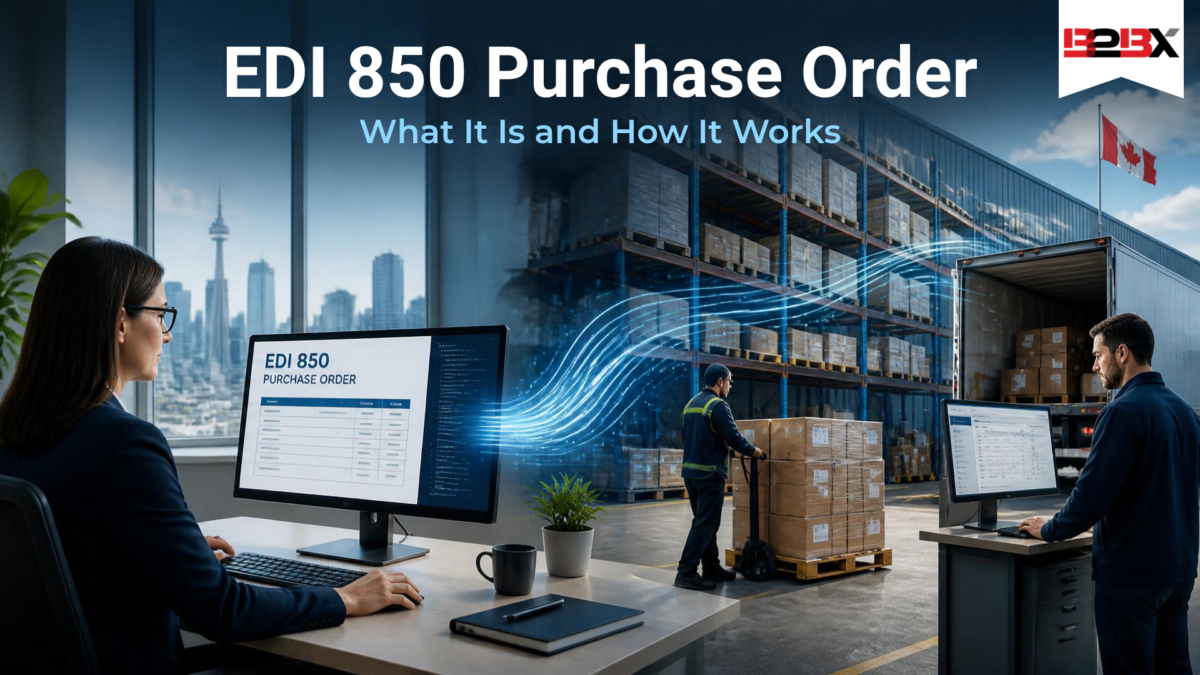
An EDI 850 Purchase Order is a standardized electronic purchase order used by buyers to send order information to suppliers. It replaces manual purchase-order exchange with structured data that can move between business systems.
For companies operating with retailers, manufacturers, distributors, and other trading partners, understanding the EDI 850 Purchase Order is important because it often starts an automated order-to-cash or procure-to-pay workflow. The document can include products, quantities, prices, delivery information, addresses, and other instructions required to process an order.
What is an EDI 850 Purchase Order?
The EDI 850 Purchase Order is the ANSI X12 transaction set used to communicate a purchase order electronically. In North America, ANSI X12 is widely used for B2B transactions, and transaction set 850 represents a purchase order.
Instead of sending a purchase order as a PDF, email attachment, or paper document, the buyer’s system creates structured transaction data. An EDI solution translates that information into the required X12 format and sends it to the supplier.
This approach allows the supplier’s systems to receive and process the order without manually re-entering every detail.
For businesses that are new to electronic document exchange, understanding the fundamentals of EDI implementation can help clarify how purchase orders connect with ERP systems, trading partners, and downstream business processes.
Who sends an EDI 850 Purchase Order?
The buyer or purchasing organization normally sends the EDI 850 Purchase Order to a supplier. The buyer may be a retailer, manufacturer, distributor, or another organization purchasing products or services.
The process usually begins in the buyer’s ERP or purchasing system. Once the order is approved, the EDI platform maps the internal order data to the trading partner’s required EDI specification.
The supplier receives the transaction, validates it, and uses the information to create or update the corresponding sales order in its own ERP or order-management system.
For businesses onboarding new partners, documenting these requirements early is important. A structured EDI trading partner onboarding process helps define message types, identifiers, connectivity, testing requirements, and partner-specific rules before production transactions begin.
How does an EDI 850 Purchase Order work?
The EDI 850 Purchase Order typically moves through several stages:
- Order creation: The buyer creates a purchase order in its ERP or procurement system.
- Data transformation: The EDI platform converts the internal data into the ANSI X12 850 format.
- Validation: The transaction is checked against technical and business requirements.
- Transmission: The document is sent through the agreed communication method.
- Supplier processing: The supplier’s EDI system receives and translates the transaction.
- ERP integration: The order information is passed into the supplier’s ERP or order-management system.
- Acknowledgment: The supplier may send an EDI 855 Purchase Order Acknowledgment to confirm receipt and communicate whether the order is accepted, rejected, or requires changes.
This automated flow reduces the need for manual data entry and creates a consistent process between trading partners.
What information is included in an EDI 850 Purchase Order?
The exact content varies by trading partner and industry, but an EDI 850 Purchase Order can contain several types of information.
Purchase order information
The transaction normally identifies the purchase order number, order date, and other references needed to connect the document to the buyer’s business process.
Buyer and supplier information
The document can identify the parties involved in the transaction, including buyer, supplier, and relevant locations.
Product and item details
Line-item information can include product identifiers, descriptions, quantities, units of measure, and other item-level information.
Pricing and totals
Depending on the trading partner specification, the transaction can include item prices, allowances, charges, currency information, and order totals.
Delivery information
The EDI 850 Purchase Order can include ship-to locations, requested delivery dates, shipping instructions, and logistics-related information.
Additional references
Trading partners may require additional reference numbers, special instructions, customer identifiers, or other data elements that support their internal processes.
Because each trading partner can define its own implementation requirements, companies should not assume that every 850 transaction has exactly the same structure.
Understanding the purchase order structure
An EDI 850 Purchase Order is organized into standardized segments and data elements. Each segment has a specific purpose, while individual elements provide the values needed to describe the order.
A simplified transaction may contain:
- An interchange and functional group envelope
- A transaction-set header
- Purchase order header information
- Dates and reference numbers
- Buyer, supplier, and ship-to information
- Line-item details
- Quantities and prices
- Order totals
- A transaction-set trailer
For example, the ST segment identifies the beginning of the transaction set, while BEG is commonly used for purchase-order beginning information. PO1 segments provide line-item details, and SE marks the end of the transaction set.
The exact segments, qualifiers, and required data elements depend on the implementation guide provided by the trading partner.
For a broader look at how electronic transactions fit into connected business processes, companies can also explore EDI and supply chain integration.
What happens after a purchase order is received?
After receiving an EDI 850 Purchase Order, the supplier’s EDI system normally validates the message before passing the information into internal applications.
Validation can check whether required fields are present, whether identifiers are recognized, whether values follow the expected format, and whether the transaction complies with the trading partner’s specifications.
A functional acknowledgment such as the EDI 997 may then confirm that the transaction was received and processed at the EDI level. This should not be confused with a business acknowledgment. An EDI 855 can communicate whether the supplier accepts the order or needs to make changes.
From there, the supplier can use the order information to plan fulfillment, inventory, warehouse activity, shipping, and invoicing.
EDI 850 vs. EDI 855
The EDI 850 Purchase Order and EDI 855 serve different purposes in the same business process.
The 850 communicates the buyer’s order to the supplier. The 855 is the supplier’s response to that order. Depending on the trading partner’s rules, the response may confirm the order, reject it, or identify changes to quantities, items, dates, or other details.
This distinction matters because receiving an 850 does not necessarily mean that every requested item has been accepted exactly as ordered. The supplier’s response provides additional information about what can actually be fulfilled.
Companies building an end-to-end EDI process should define these transaction relationships as part of their EDI compliance requirements.
Common purchase order errors
An EDI 850 Purchase Order can fail or require manual intervention when the data does not match the supplier’s implementation requirements.
Common issues include:
- Incorrect or missing item identifiers
- Invalid ship-to locations
- Prices that do not match agreed terms
- Missing required reference numbers
- Incorrect units of measure
- Invalid dates or delivery information
- Trading partner-specific formatting errors
- Master data that has not been synchronized between systems
These problems can interrupt automated processing even when the EDI connection itself is working correctly.
For this reason, EDI projects should address data quality, mapping, testing, exception handling, and partner-specific requirements rather than focusing only on connectivity.
Organizations dealing with multiple trading partners can also review common EDI provider mistakes that can affect data quality, compliance, and transaction processing.
Why use an electronic purchase order?
The EDI 850 Purchase Order supports automated procurement and order processing by moving structured information directly between connected business systems.
For buyers and suppliers, this can help:
- Reduce manual data entry
- Accelerate order processing
- Improve consistency between trading partners
- Reduce transcription errors
- Support higher transaction volumes
- Improve visibility across purchasing workflows
- Create a foundation for connected shipping and invoicing processes
The value becomes more significant when a company exchanges large numbers of orders or works with multiple trading partners that have different requirements.
An integrated EDI environment can also connect purchase orders with other business documents, allowing information to flow from ordering through acknowledgment, shipment, and invoicing.
The purchase order in the broader EDI workflow
The EDI 850 Purchase Order is usually only one step in a larger transaction flow.
A common retail or distribution workflow can include:
EDI 850 Purchase Order → EDI 855 Purchase Order Acknowledgment → EDI 856 Advance Ship Notice → EDI 810 Invoice
The exact sequence depends on the industry and the requirements of each trading partner. Some organizations may also use other transaction sets for inventory updates, order changes, payment information, or additional logistics processes.
For example, an EDI 860 can be used to communicate changes to a previously submitted purchase order. This allows the overall process to continue electronically when order details need to be modified.
How to prepare your business for EDI 850 transactions
Before exchanging an EDI 850 Purchase Order in production, companies should establish clear requirements with each trading partner.
Start by identifying:
- Which EDI standard and version the partner requires.
- Which transaction sets must be supported.
- Which identifiers and codes must be used.
- Which fields are mandatory.
- Which communication protocol will be used.
- How acknowledgments and errors will be handled.
- What testing and certification process is required.
- How the EDI flow will connect with the ERP or other internal systems.
This preparation is particularly important when a customer requires EDI as part of its supplier relationship. Companies can benefit from understanding the complete EDI implementation process before committing to production connectivity.
Final thoughts
The EDI 850 Purchase Order is more than a digital version of a traditional purchase order. It is a standardized transaction that allows buyers and suppliers to exchange structured order information and connect purchasing activities with broader automated business processes.
Understanding how the transaction is created, transformed, transmitted, validated, and integrated helps companies identify where errors can occur and what their trading partners expect.
For organizations managing multiple customers or suppliers, the goal is not simply to send an 850 file. The objective is to build a reliable process in which purchase orders move accurately from the buyer’s system to the supplier’s systems and continue through the appropriate acknowledgment, fulfillment, shipping, and invoicing steps.
Talk to an EDI expert and find the right approach for your business.